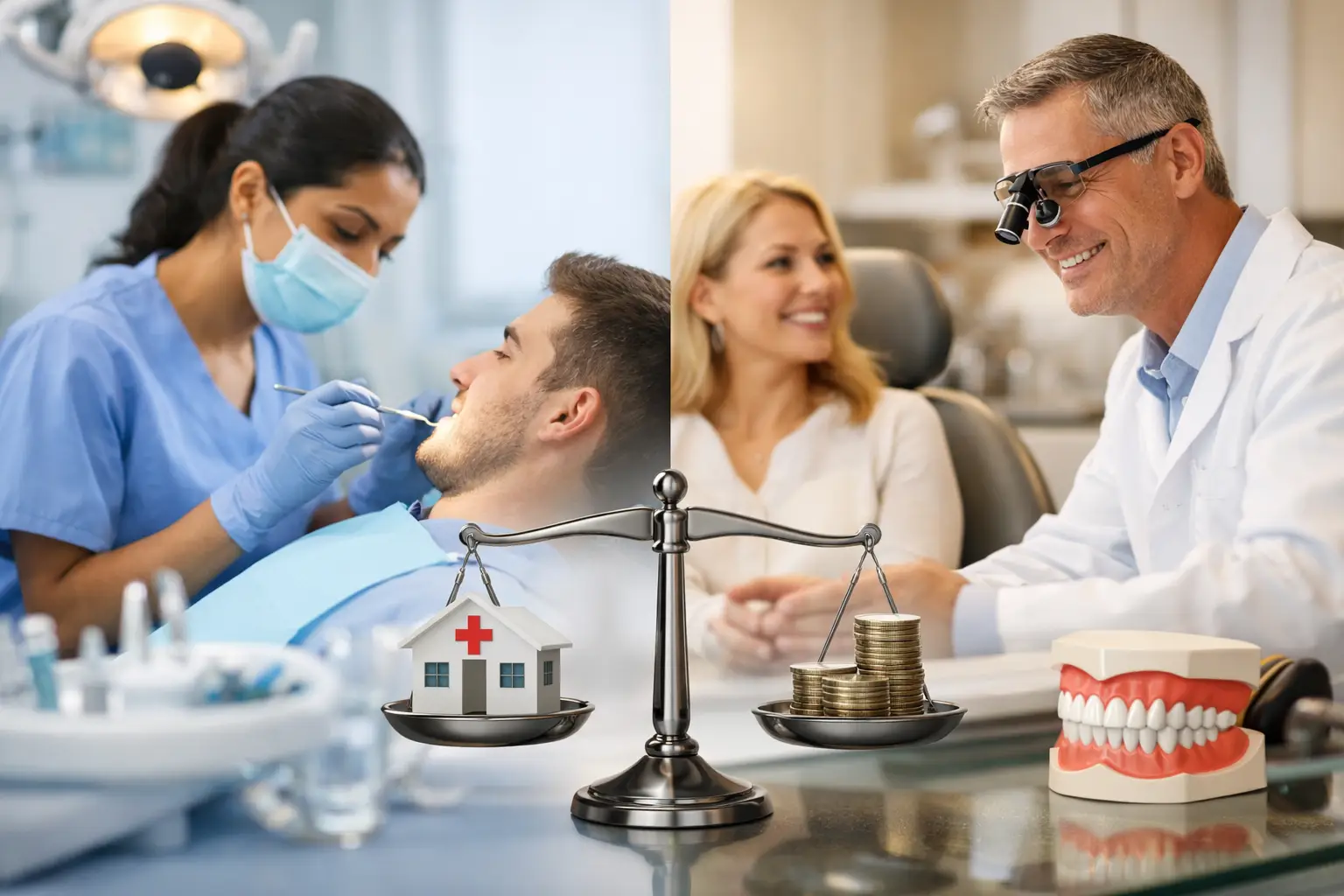
NHS Private Dental Treatment Cost Explained
Understand nhs private dental treatment cost, what NHS covers, what private fees include, and how to choose the right option for your care.

When patients ask about NHS private dental treatment cost, they are rarely looking for a single figure. More often, they want to know why one treatment is covered, another is not, and whether paying privately actually offers better value for their situation. That is a fair question, especially when dental care can range from routine maintenance to more complex restorative work.
The clearest place to start is this: NHS and private dentistry are built around different fee structures, different treatment rules and, in some cases, different patient priorities. Neither is automatically better in every circumstance. The right option depends on the treatment you need, how quickly you want to be seen, the materials involved and the standard of flexibility or continuity you expect from your care.
What NHS private dental treatment cost really means
The phrase NHS private dental treatment cost can sound as though NHS and private fees sit on a single sliding scale. In practice, they do not. NHS dental charges are set within a regulated framework, with treatments grouped into standard bands where applicable. Private treatment fees, by contrast, are set by the practice and reflect the time required, the materials used, the complexity of the procedure and the clinical planning involved.
That distinction matters because two treatments that seem similar on the surface may be priced very differently depending on how they are delivered. A basic filling under the NHS is not priced in the same way as a tooth-coloured private filling chosen for aesthetics, precision or longevity. Likewise, a denture that restores function under NHS criteria is different from a more bespoke private option designed around appearance, fit and material quality.
This is often where confusion begins. Patients understandably compare the end result - a repaired tooth, a replacement tooth, a cleaner smile - but the route to that result may not be equivalent.
What NHS dental treatment usually covers
NHS dentistry is designed to provide clinically necessary treatment to keep your mouth healthy. That includes examinations, diagnoses, preventive advice and many routine treatments such as fillings, extractions and certain crowns or dentures where they are considered necessary.
For many adults and families, this is a valuable and affordable route into ongoing dental care. It supports regular maintenance and can be especially helpful if your needs are straightforward and your priority is access to essential treatment rather than elective upgrades.
What NHS care does not generally cover is treatment chosen mainly for cosmetic reasons. Teeth whitening is a clear example. Clear aligners would usually sit outside NHS provision for adults unless there are specific clinical grounds and eligibility criteria. Dental implants are another treatment that are not routinely available under the NHS except in limited circumstances.
Even within treatments that can be provided on the NHS, there may be practical limitations around materials, laboratory options or aesthetic choices. That is not a criticism of NHS dentistry. It is simply a reflection of how a public healthcare system is designed to allocate care fairly and consistently.
What private dental fees are paying for
Private care gives more flexibility in how treatment is planned and delivered. In some cases, patients are paying for access to treatments that are not available on the NHS at all. In others, they are paying for more choice - more time, more advanced materials, more detailed cosmetic planning or greater convenience.
A private examination may involve more time for discussion around long-term goals, especially if you are weighing up options such as crowns, whitening, aligners or implants. A private hygiene visit may allow for a more tailored maintenance plan if you have gum concerns, staining or a history of dental anxiety. More advanced restorative work often includes laboratory craftsmanship, careful shade matching and staged planning that go beyond the scope of standard NHS provision.
Private fees also tend to reflect continuity. Patients often value seeing the same clinician over time, having treatment explained calmly and clearly, and being able to plan care at a pace that feels manageable. For nervous patients in particular, that experience is not a luxury. It can be the difference between avoiding treatment and feeling able to proceed.
Why the cost difference can be significant
When comparing NHS and private treatment costs, it helps to look at four factors: clinical necessity, complexity, materials and time.
Clinical necessity determines whether a treatment may be offered under NHS criteria at all. Complexity affects how much planning and chair time is required. Materials make a visible difference in many restorative and cosmetic treatments. Time is often the hidden factor, yet it has a direct bearing on quality, comfort and predictability.
Take crowns as an example. An NHS crown may be entirely appropriate where the main goal is to protect a damaged tooth. A private crown may involve more aesthetic customisation, a different material, closer shade matching and more detailed preparation. Both restore the tooth, but they are not identical services.
The same applies to dentures. One patient may simply want a functional replacement to restore chewing. Another may be concerned about speech, fit, facial support and natural appearance. Private treatment can offer more scope to refine these details, but that naturally changes the fee.
Common treatments where patients compare NHS and private costs
Patients most often compare costs in treatments that sit between health, comfort and appearance. Fillings are one example. If the tooth is visible when you smile, a tooth-coloured private filling may feel more appropriate than a less aesthetic alternative. Hygienist visits are another area where patients may choose private care for regular stain removal, gum support and preventive attention.
Crowns, bridges and dentures often raise more detailed questions because they replace or rebuild damaged teeth in ways that affect both function and confidence. Teeth whitening and clear aligners are usually more straightforward from a cost perspective because they are generally private treatments. Implants also sit firmly in the private category for most patients, largely due to the surgical skill, planning and laboratory work involved.
Emergency appointments can blur the line slightly. Urgent care may be available under NHS arrangements depending on circumstances, but private emergency appointments are often chosen for speed, convenience or where a patient is not registered elsewhere.
How to judge value, not just price
The cheapest treatment is not always the most economical over time, and the highest fee is not automatically the best option either. Good value comes from matching the treatment to the clinical problem, your expectations and your budget.
If you need a straightforward repair and are happy with an NHS solution, that may be the right decision. If you are investing in a front tooth, replacing a missing tooth or choosing treatment that will affect confidence as well as oral health, private care may offer benefits that justify the added cost.
It is also worth thinking about longevity and maintenance. A treatment that fits well, functions properly and is planned with care may reduce the likelihood of future problems. That said, even excellent dentistry is not permanent. Teeth, gums and restorations all need ongoing review. A sensible conversation about likely lifespan, upkeep and alternatives is often more useful than focusing on the initial fee alone.
Questions worth asking about NHS private dental treatment cost
If you are unsure which route to take, ask practical questions rather than broad ones. Ask whether the treatment is clinically necessary, whether it is available on the NHS, what the private option adds and whether there are staged alternatives if cost is a concern.
You should also feel comfortable asking what is included in the quoted fee. Does it cover X-rays, temporary restorations, review appointments or laboratory work? If a treatment has aesthetic elements, ask how much flexibility there is in the final look. If you are nervous, ask how much time is allowed and whether continuity with the same clinician is possible.
A good practice will answer these questions clearly and without pressure. Transparent pricing and calm explanation are part of good patient care, not an extra.
Choosing the right option for your circumstances
For some patients, the answer is simple. NHS care meets their needs well and offers an affordable way to maintain oral health. For others, private treatment makes sense because they want specific cosmetic results, more complex rehabilitation or a more tailored experience.
Many patients use both over time. They may attend for routine care and then choose private treatment for whitening, aligners, implants or certain restorative procedures. That blended approach can be entirely sensible. It reflects the reality that dentistry is not one-size-fits-all.
At an established Edinburgh practice such as 4 Great Stuart Street, the aim should not be to steer patients towards the most expensive option. It should be to explain choices honestly, recommend treatment ethically and help patients feel confident in the decision they make.
If you are weighing up cost, the most useful next step is not to search for a single average price. It is to understand what you are being offered, why it is recommended and how it fits your long-term dental health. A calm, well-explained treatment plan is often worth far more than the headline figure alone.