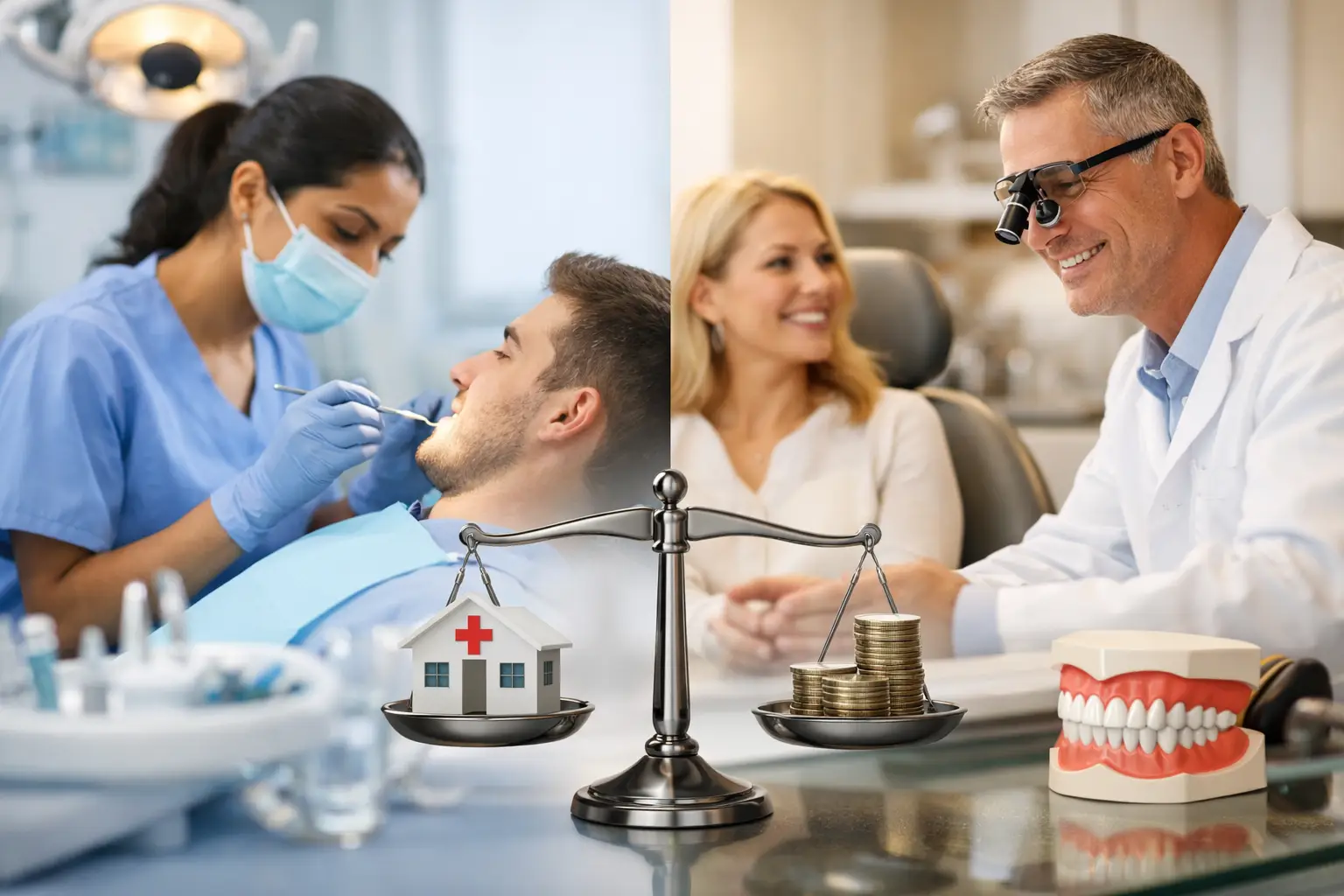
NHS vs Private Dental Care Explained
Confused about nhs vs private dental care? Compare costs, access, treatment options and ongoing care to choose what suits you best.
When people compare NHS vs private dental care, they are usually not asking a theoretical question. They are trying to work out what happens when a filling breaks, a child needs regular check-ups, or a long-delayed problem finally needs attention. In practice, the right choice depends on your priorities - cost, access, treatment options, continuity and how much flexibility you want in your care.
For many patients in Edinburgh, the answer is not as simple as picking one side and dismissing the other. NHS dentistry plays an essential role in making routine care accessible. Private dentistry can offer more choice, shorter waits and access to treatments that sit outside NHS provision. The most sensible decision often comes from understanding what each route is designed to do.
NHS vs private dental care: the main difference
At the simplest level, NHS dental care is designed to provide clinically necessary treatment to keep your mouth healthy. Private dental care covers the same core aim of oral health, but it can also offer a broader range of treatment choices, materials, appointment options and cosmetic solutions.
That distinction matters. Under the NHS, the focus is necessity. If you need an examination, hygiene advice, fillings, treatment for pain, dentures or other essential care, NHS dentistry is there to help maintain oral health and function. Private dentistry can include those basics too, but it often gives patients more say over how treatment is delivered, the time allowed, and the aesthetic options available.
Neither approach is inherently better in every circumstance. NHS care is invaluable and appropriate for many patients. Private care may be the better fit where convenience, advanced restorative options or cosmetic goals are part of the picture.
Cost matters - but so does value
For most people, cost is the first point of comparison. NHS dental charges are generally lower and more predictable for eligible treatments, which makes a real difference for families, older patients and anyone trying to manage household budgets carefully.
Private treatment is usually more expensive, but the price reflects a different model of care. Appointments may be longer. There may be greater flexibility around scheduling. More treatment options may be available, including higher-end restorative and cosmetic work. In some cases, patients are not simply paying for the treatment itself, but for time, choice and convenience.
That does not mean private care is only for major cosmetic work. Many patients choose private dentistry for routine care because they value being able to stay with a particular clinician, book appointments more easily, or discuss treatment in greater detail. Equally, many patients are very well served by NHS dentistry for their ongoing maintenance and essential treatment.
The key question is not only what something costs today, but what kind of support you want over time.
Access and waiting times
One of the most common reasons patients consider private care is access. In some areas, finding an NHS dentist accepting new patients can be difficult. Even when you are already registered, availability for non-urgent treatment may vary depending on demand.
Private care can sometimes offer more flexibility, particularly for busy professionals, parents juggling school schedules, or anyone who wants appointments with less delay. That may include early or more convenient appointment times, as well as faster progression from diagnosis to treatment.
This is especially relevant when a problem is affecting daily life. A damaged tooth, broken crown or persistent discomfort may not always be a medical emergency, but it can still feel urgent. In those situations, the ability to be seen promptly can make a significant difference to comfort and peace of mind.
Treatment choice and materials
This is where the difference between NHS and private dentistry often becomes clearer.
NHS treatment is based on what is clinically necessary. That means the aim is to restore function and health in a safe, effective and affordable way. It is not generally designed around cosmetic preference. If a filling, crown or denture is needed, the NHS route provides treatment that is appropriate and serviceable, but not necessarily the most discreet or individually tailored option available.
Private care tends to allow more choice in materials and planning. For example, a patient may want a crown that blends more naturally with surrounding teeth, or they may be considering treatments such as whitening, clear aligners or dental implants. These are typically private options.
The same applies to more complex restorative work. If a tooth is badly damaged or missing, there may be several ways to deal with it. One patient may be happy with the most straightforward functional solution. Another may want a longer-term option that feels more secure, looks more natural or preserves surrounding teeth more effectively. Private dentistry can widen those choices.
Prevention and continuity of care
Good dentistry is not only about fixing problems. It is about helping patients avoid them.
Both NHS and private dentists place strong emphasis on preventive care, but the patient experience can differ. In private practice, there is often more scope for longer conversations about brushing habits, gum health, diet, grinding, wear, and future planning. That extra time can be particularly valuable for nervous patients or for people with a more complicated dental history.
Continuity also matters. Seeing the same dentist regularly builds trust and makes it easier to spot subtle changes over time. A clinician who knows your history is often better placed to advise whether something can be monitored, needs treatment now, or may become a larger issue later.
For families, this consistency can be reassuring. Children often do better when dental visits feel familiar. Adults who have had difficult experiences in the past also tend to feel more comfortable when care is calm, predictable and relationship-based rather than rushed.
NHS vs private dental care for cosmetic and advanced treatment
If your concern is mainly cosmetic, private dentistry is usually the more relevant route.
Treatments such as teeth whitening, clear aligners and dental implants are generally outside the scope of standard NHS dental care except in very limited circumstances. The same is often true of elective improvements where the goal is not simply to restore health, but to improve appearance, confidence or comfort.
That does not make cosmetic treatment frivolous. A person who feels self-conscious about worn, uneven or missing teeth may be dealing with something that affects speech, eating, work and social confidence. Private dentistry can offer solutions that are both functional and aesthetic, especially when treatment planning takes a long-term view.
At an established practice such as 4 Great Stuart Street, that balance between everyday care and more advanced treatment is often what patients value. They can attend for routine examinations and hygiene support, while also having access to crowns, dentures, aligners or implants if their needs change.
Which option suits anxious patients?
For anxious patients, the quality of the relationship can matter as much as the treatment itself.
NHS clinicians are highly skilled at caring for nervous patients, but pressures on time and availability can sometimes make the experience feel more functional. Private care may offer a calmer pace, more time for explanation and a setting that feels less hurried. That can make a meaningful difference if fear has led someone to postpone care.
Still, it would be wrong to suggest that anxiety automatically means private treatment is necessary. What matters most is feeling listened to, respected and not judged. A safe, ethical and relaxed environment is possible in either setting, but patients who need more time often appreciate a practice model built around continuity and personal support.
So how should you decide?
A good starting point is to ask what you need from your dentist over the next few years, not just at your next appointment. If your main priority is affordable access to essential care, NHS dentistry may suit you very well. If you want broader treatment options, more flexibility, or are considering cosmetic or complex restorative work, private care may be the better fit.
Some patients are also open to a blended approach. They may prioritise NHS care for routine essentials while choosing private treatment for services outside NHS scope. That can be a practical middle ground, particularly when balancing budget with personal preference.
It is also worth thinking about how you like to make healthcare decisions. Some people want the most cost-effective clinically appropriate option and are happy with that. Others want a full discussion of alternatives, materials, longevity and appearance before deciding. Neither approach is wrong. They simply reflect different priorities.
The best dental care is the care you can access, understand and continue with confidently. If a practice is transparent about costs, clear about your options and focused on long-term oral health, you are already in a strong position to make the choice that suits you and your family.