Dentures or Dental Implants?
Dentures or dental implants - understand the differences, costs, comfort and long-term benefits to choose the right option with confidence.
Losing a tooth, or several teeth, rarely feels like a simple dental issue. It affects how you eat, how clearly you speak, and often how comfortable you feel smiling. If you are weighing up dentures or dental implants, the right choice is not always the most obvious one. It depends on your oral health, your priorities, your budget and how you want your teeth to feel day to day.
For some patients, dentures offer a reliable and more affordable way to replace missing teeth. For others, implants provide a longer-term solution that feels closer to a natural tooth. Neither option is universally better. The best decision is the one that suits your mouth, your lifestyle and your expectations.
Dentures or dental implants: what is the difference?
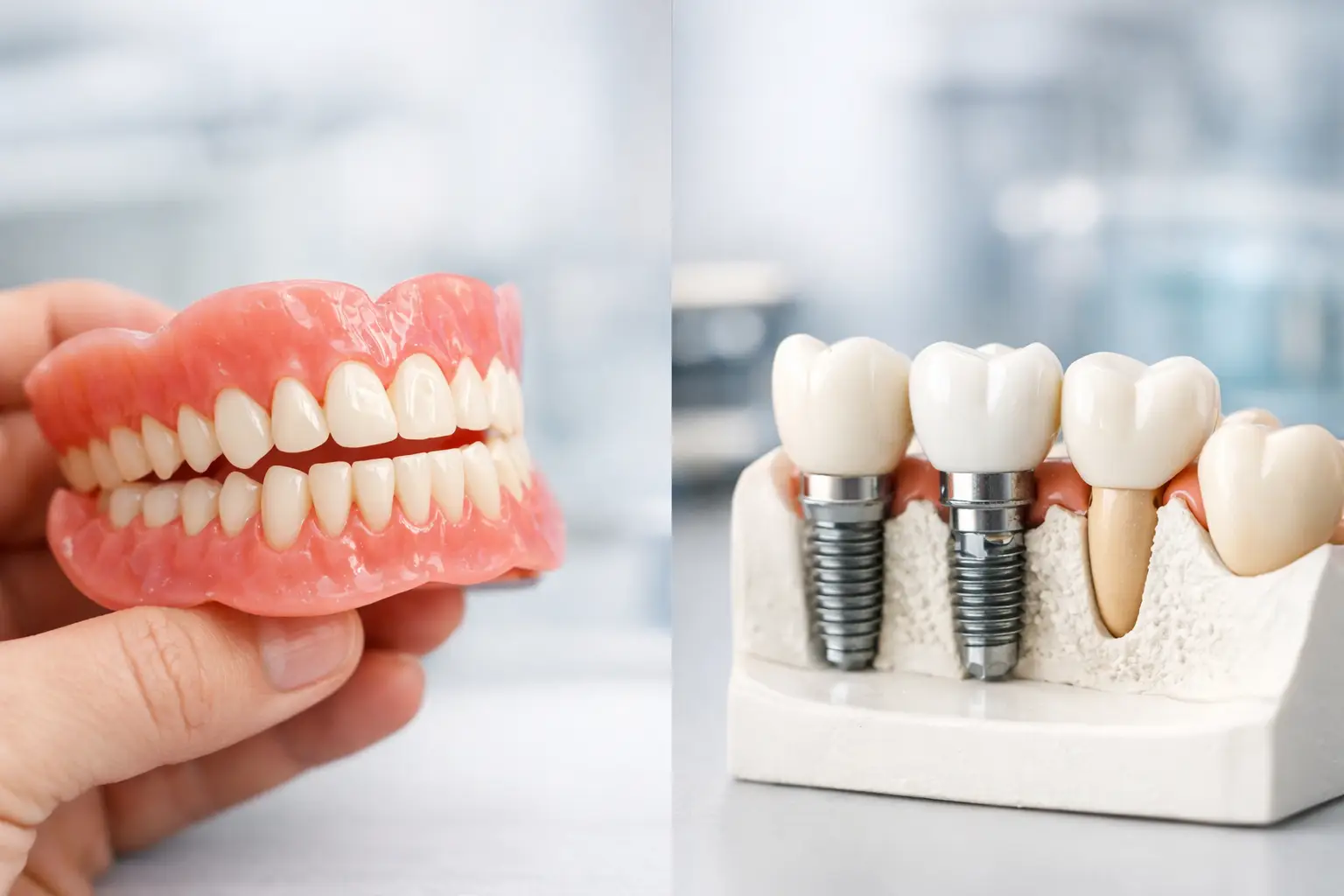
Dentures are removable appliances that replace one, several or all missing teeth. They sit on the gums and are carefully shaped to restore appearance and function. Modern dentures can look natural and, when well made, can make a significant difference to comfort and confidence.
Dental implants work differently. An implant is a small titanium post placed into the jawbone to act as an artificial tooth root. Once it has healed and integrated with the bone, it can support a crown, bridge or, in some cases, help secure a denture more firmly.
That difference in structure matters. Dentures rest on the gum. Implants are fixed in the jaw. As a result, they tend to feel more stable, but they also involve a surgical procedure and a longer treatment journey.
When dentures may be the better choice
Dentures remain an excellent option for many patients, particularly when several teeth are missing. They are often chosen because treatment is straightforward, the cost is lower than implants, and they can restore the smile without surgery.
For someone who has lost a number of teeth over time, dentures can offer an efficient solution that improves chewing and appearance reasonably quickly. They can also be a sensible option if bone levels are not suitable for implants, or if a patient would prefer to avoid surgery for medical or personal reasons.
There is also the question of flexibility. Dentures can be adjusted or remade if the mouth changes over time. That can be helpful, especially where gum shape or remaining teeth are likely to change.
That said, dentures do come with compromises. Because they are removable, they can move slightly when eating or speaking, particularly lower dentures. Some patients adapt very well. Others never fully enjoy the feeling of wearing them. A denture also does not stimulate the jawbone in the same way as a tooth root, so some degree of bone shrinkage can continue over the years.
When dental implants may be the better choice
Implants are often appealing because they feel secure and natural. If you are replacing a single missing tooth, an implant can do so without relying on neighbouring teeth for support. If several teeth are missing, implants can also help stabilise bridges or dentures.
Many patients choose implants because they want to eat with more confidence and avoid the movement that can come with removable dentures. They can be especially helpful for people who have struggled with a loose lower denture, or who simply want a fixed option that becomes part of everyday life.
There is a longer-term benefit too. Because implants sit in the jawbone, they can help maintain bone levels in a way dentures cannot. That can support facial shape and oral health over time.
Still, implants are not the right answer for everyone. They require adequate bone, healthy gums and careful planning. The treatment takes longer than dentures, as healing time is needed after placement. They also involve a higher initial cost, which is an important and perfectly reasonable factor for many households.
Comfort, confidence and day-to-day living
When patients ask whether dentures or dental implants are better, they are often really asking a more personal question: which will let me get on with life more comfortably?
Dentures can work very well, but there is usually an adjustment period. Eating may feel different at first, and certain foods can remain awkward. Speech can also take a little practice while the cheeks and tongue adapt. Good denture design makes a real difference, but it is still a removable appliance.
Implants generally feel closer to natural teeth once treatment is complete. There is no need to remove them at night, and there is often less self-consciousness around slipping or movement. For many people, that added confidence is a major part of the value.
The trade-off is that implants ask more of you at the start. You need assessment, planning, healing and excellent home care. Dentures are simpler to provide, but may ask more patience in daily wear.
Cost matters, and it should
It is entirely sensible to consider cost carefully. Dentures are usually the more affordable option upfront, which makes them a practical route for many patients who want to restore function and appearance without a significant financial commitment.
Implants usually cost more because they involve surgery, advanced planning and more clinical time. However, cost should be weighed alongside longevity, maintenance and quality of life. A lower upfront fee does not always mean lower long-term cost, particularly if a patient struggles with repeated adjustments, remakes or dissatisfaction.
This is where honest advice matters. A good treatment recommendation should not push you towards the most complex option. It should help you understand what you are paying for, what results are realistic and where the value lies for your particular needs.
Are you suitable for both options?
Not every patient is suitable for implants straight away. Gum disease, smoking, certain medical conditions and reduced bone volume can all affect whether implant treatment is advisable. Sometimes implants are still possible with additional planning or preparatory treatment, but that is a clinical decision that needs careful assessment.
Dentures are suitable for a wider range of patients, which is one reason they remain so important in modern dentistry. They can replace teeth effectively even where bone loss has already occurred.
Suitability is not only about clinical health, though. It is also about preference. Some patients dislike the idea of surgery and are perfectly happy with a removable option. Others strongly prefer a fixed replacement and are willing to invest more time and money to achieve that.
Dentures or dental implants for one tooth or many?
If one tooth is missing, an implant is often the closest substitute for a natural tooth, provided the conditions are right. A single denture tooth is possible in some cases, but many patients find an implant neater and more secure.
If several teeth are missing, the answer becomes more nuanced. A partial denture may be the simplest and most cost-effective choice. Equally, implants may be used to support a bridge or to retain a denture so it feels much more stable.
For full arch tooth loss, traditional full dentures are still common and can be very successful. Yet for patients frustrated by looseness, especially in the lower jaw, implant-retained dentures can offer a notable improvement. This can be a useful middle ground - more secure than a conventional denture, but often less extensive than a full set of fixed implant teeth.
The value of a calm, personalised assessment
Choosing between dentures and implants should never feel rushed. A proper consultation looks at more than the gap in your smile. It considers the condition of your gums, the amount of bone available, the health of neighbouring teeth, your medical history, your budget and how you feel about treatment.
It should also include a frank conversation about maintenance. Dentures need daily cleaning and periodic review. Implants need excellent oral hygiene and regular professional care to keep the surrounding gum healthy. Neither option is a one-off fix that can be forgotten.
At an established practice such as 4 Great Stuart Street, that discussion is part of helping patients make informed, comfortable decisions rather than pressured ones. For many people, reassurance and continuity of care are just as important as the treatment itself.
What usually matters most in the final decision
Most patients do not decide based on one factor alone. They balance comfort, appearance, cost, treatment time and long-term confidence. Someone who wants the most secure feel and is suitable for treatment may lean towards implants. Someone who wants a reliable, more accessible solution without surgery may feel happier with dentures.
There is no shame in choosing the simpler option if it suits your circumstances. Equally, there is good reason to invest in implants if the benefits matter to you and the treatment is appropriate. The aim is not to choose the most advanced option on paper. It is to choose the option that lets you eat, speak and smile with greater ease.
If you are deciding between dentures or dental implants, the most useful next step is not to compare yourself with somebody else. It is to have your own mouth assessed properly, ask clear questions and choose the route that feels right for your health, your life and your peace of mind.