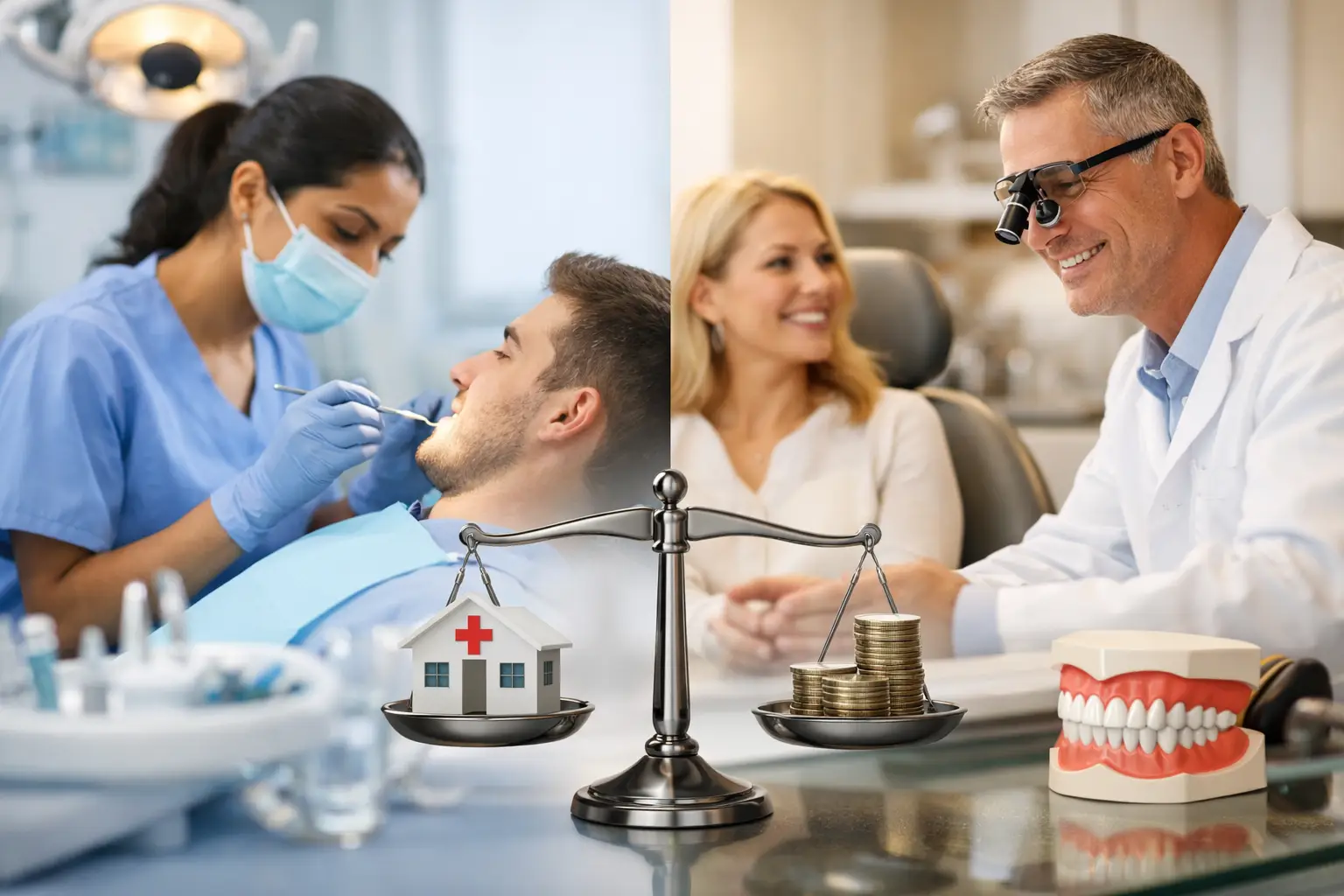
Can NHS Dentists Do Private Work?
Can NHS dentists do private work? Yes - but the rules matter. Learn how NHS and private dental care can be offered clearly and fairly.

If you have ever looked at a treatment plan and wondered, can NHS dentists do private work, you are not alone. It is a very common question, especially when a practice offers both NHS and private care and patients want to understand what is covered, what is optional and how decisions should be made.
The short answer is yes. An NHS dentist can also provide private treatment. Many practices do exactly that. What matters is that the two are kept clearly separate, that patients are told what their options are, and that no one is pressured into paying privately for treatment that is available on the NHS and clinically appropriate.
For patients, the confusion often comes from the fact that the same dentist, in the same surgery, may provide both types of care. That can feel unclear unless it is properly explained. In reality, the distinction is not about who the dentist is. It is about which treatment is being provided, under which arrangement, and how that care is charged.
Can NHS dentists do private work in the same practice?
Yes, they can. A dentist may work under an NHS contract for some patients or treatments and offer private care for others. Many established practices use this mixed model because it allows them to provide routine dental care through the NHS while also offering treatments that fall outside NHS funding, such as cosmetic whitening, certain aesthetic options or more advanced restorative solutions.
That said, there are rules. An NHS dentist cannot simply blur NHS and private care into one bill. If part of your treatment is NHS and part is private, this should be explained plainly before treatment starts. You should know which elements are clinically necessary under the NHS, which are private choices, and what the fees are for each.
This matters because trust in dentistry is built on clarity. Most patients do not want a complicated policy explanation. They simply want to know what they need, what their options are and what each route involves.
How NHS and private dental treatment differ
The NHS is there to provide treatment that is clinically necessary to keep your mouth, teeth and gums healthy. Private dentistry can include that same core care, but it also allows greater flexibility in materials, appointment time, cosmetic options and treatment planning.
Sometimes the difference is straightforward. Teeth whitening, for example, is a private treatment because it is cosmetic. In other cases, the distinction is more nuanced. A crown may be clinically necessary, but the type of crown, the material used or the laboratory work involved may differ between NHS and private care.
This is where patients can understandably feel uncertain. If a treatment exists on both sides, why would anyone choose private care? Often it comes down to preference, appearance, convenience or complexity. A patient may want a more natural-looking restoration, longer appointments, a particular cosmetic finish or a wider range of options. Another patient may be perfectly happy with the NHS route. Neither choice is inherently right or wrong.
When private treatment may be offered
A private option may be discussed when a treatment is not available on the NHS, when there are different materials or cosmetic outcomes to consider, or when the patient wants an elective treatment rather than a clinically necessary one.
For example, if a tooth needs restoring, an NHS solution may be entirely suitable for health and function. A private option may then offer a different appearance or a broader choice of materials. The important point is that the dentist should explain this in balanced terms. Private treatment should be presented as an option, not a pressure tactic.
Patients should also be told if there is an NHS treatment available that would address the clinical need. You may still prefer the private option, but the decision should be properly informed.
What dentists must not do
The question can NHS dentists do private work sometimes comes with a second concern: can they refuse NHS treatment and push people into private care? The answer is that dentists must follow NHS rules and professional standards. They should not ask you to pay privately for treatment that is available under the NHS if the only reason is financial convenience for the practice.
They also should not mix NHS and private treatment within the same course of treatment in a way that is misleading. If a course of treatment is NHS, you should be charged accordingly. If you choose a private alternative for part of your care, that should be clearly set out, agreed in advance and documented properly.
Good practices make this easy to understand. You should receive a treatment plan, fee information and enough time to ask questions. If anything feels vague, it is reasonable to ask for a clearer explanation before going ahead.
Why some patients choose private care
Private dental care is not only about cosmetic treatment. For some patients, it is about access, flexibility and continuity. Longer appointments can help nervous patients feel less rushed. A wider choice of restorative and cosmetic treatments can be important if someone wants to improve both function and appearance. In more complex cases, such as implants, aligners or detailed rebuilding work, private care often allows a broader treatment plan.
There is also a practical side. Some patients want to stay with one trusted dentist for routine care and then choose private treatment only when they need something beyond standard NHS provision. That can be a sensible middle ground.
In Edinburgh, where patients often balance busy working lives with family commitments, convenience and continuity do matter. Seeing the same team in a calm, established setting can make a real difference, particularly if you are anxious about treatment or managing care for children as well as yourself.
How to tell if a practice is handling this properly
A well-run practice should be transparent from the outset. You should know whether you are being seen as an NHS or private patient for a particular appointment or course of treatment. If both options exist, the difference should be explained in plain English rather than dense jargon.
It is also a good sign when a dentist explains the clinical need first and the payment route second. That keeps the focus where it belongs - on your health. Once that is clear, you can discuss whether an NHS option is suitable or whether a private treatment better meets your priorities.
At a practice built on trust, there should be no sense of being hurried into a decision. Patients need space to consider cost, timing, appearance and long-term maintenance. A calm conversation is often all it takes to make the choices feel clear.
Questions worth asking at your appointment
If you are unsure whether a proposed treatment is NHS or private, ask directly. You can also ask whether there is an NHS alternative, what the practical difference would be, and whether the result would differ in function, appearance or longevity.
These are not awkward questions. They are sensible ones. Any professional practice should be comfortable answering them clearly.
You may also want to ask what happens if your needs change during treatment. Occasionally a plan evolves once the dentist has more information. If so, any change from NHS to private, or vice versa, should still be explained and agreed with you.
A balanced view for patients
So, can NHS dentists do private work? Yes, absolutely. In many practices, offering both is part of giving patients more choice. NHS care remains vital for essential treatment, while private care can extend what is possible in terms of aesthetics, materials, convenience and advanced options.
The key issue is not whether a dentist offers both. It is whether they do so openly, ethically and in a way that helps patients make confident decisions. Good dentistry should never feel like a sales process. It should feel informed, respectful and proportionate to your needs.
At 4 Great Stuart Street, that principle matters. Patients benefit most when they understand their options clearly and feel supported rather than steered.
If you are ever uncertain about whether a treatment should be NHS or private, the best next step is often the simplest one - ask for a clear explanation, and expect one.