Can Adults Get Clear Aligners? What to Consider
Can adults get clear aligners? Learn who they suit, what treatment involves, and how a careful dental assessment supports a healthy, confident smile too.
A slightly crowded lower tooth, a front tooth that has shifted over the years, or a gap that has always drawn your eye in photographs can feel more noticeable in adulthood. So, can adults get clear aligners? In many cases, yes. Clear aligner treatment can be an effective and discreet way for adults to straighten teeth, provided the teeth, gums and bite are suitable for orthodontic movement.
Age alone is rarely the deciding factor. What matters more is the health of your mouth, the type of movement required and whether you can wear the aligners consistently. A careful assessment gives you a realistic answer before treatment begins, without pressure or exaggerated promises.
Can adults get clear aligners at any age?
There is no fixed upper age limit for clear aligners. Adults in their thirties, forties, fifties and beyond can have orthodontic treatment successfully. Teeth can continue to move throughout life because the supporting bone responds to gentle, controlled forces.
However, adult treatment needs thoughtful planning. Unlike many teenagers, adults may have crowns, bridges, fillings, gum recession or previous tooth wear to consider. These do not automatically rule out aligners, but they can affect what is possible and how treatment should be designed.
The starting point is healthy foundations. Your dentist will look for signs of active gum disease, untreated decay, infection and other problems that should be addressed first. Moving teeth when the gums are inflamed or the supporting bone is compromised is not a sensible shortcut. A straight smile should also be a healthy, comfortable one.
What can clear aligners treat?
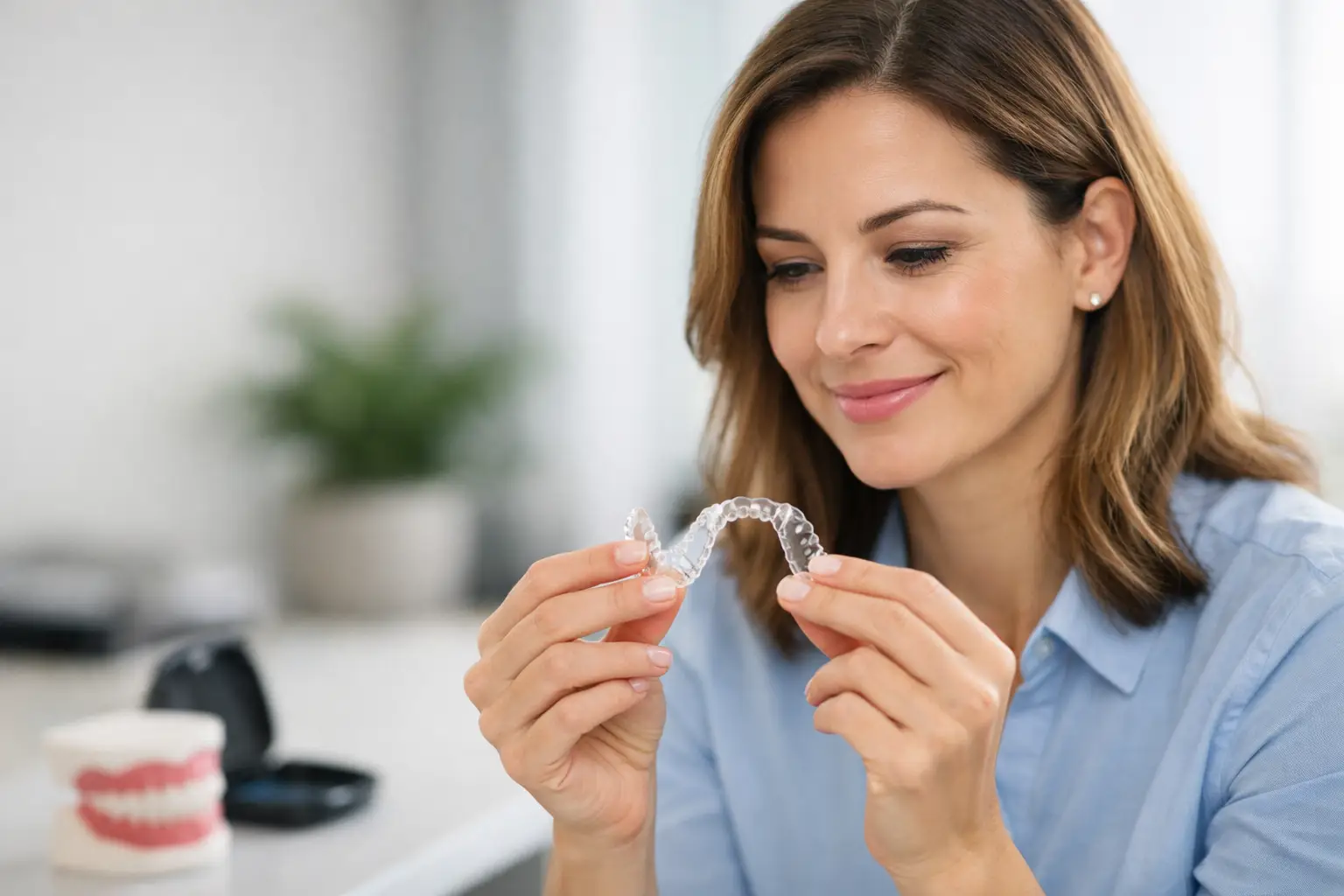
Clear aligners are transparent, removable trays made to fit closely over your teeth. You wear each set in sequence, usually changing to the next set at intervals advised by your dentist. Each aligner applies small, planned movements over time.
For suitable adult cases, aligners can improve mild to moderate crowding, spacing, rotated teeth and some bite concerns. They are often appealing to people who would prefer an understated alternative to fixed braces at work, social occasions or family events.
The word "clear" deserves a little perspective. Aligners are discreet, not invisible. Some treatments use small tooth-coloured attachments to give the aligners a better grip, and these can be visible at close range. Small amounts of enamel may occasionally need to be polished between teeth to create the space needed for safe movement. Both are routine parts of treatment when clinically appropriate, and should be explained clearly before you agree to proceed.
More complex cases may still be treatable with aligners, but may need a longer plan, additional techniques or fixed braces. Significant bite discrepancies, severely rotated teeth, impacted teeth or changes involving the jaw can require a different approach. The right treatment is the one that manages the clinical problem properly, rather than the one that happens to look most convenient.
Existing crowns, implants and dental work
Many adults considering tooth straightening already have restorative dental work. A crowned tooth can sometimes be moved with the surrounding teeth, although each case needs individual assessment. Implants, on the other hand, are fixed within the jawbone and cannot be moved orthodontically.
This is particularly relevant if you are considering a crown, bridge or implant for a missing or damaged tooth. In some cases, it is best to move the natural teeth first, then complete the final restorative work once the positions are stable. Planning treatment in the right order can avoid unnecessary replacement work and help achieve a more balanced result.
The commitment matters as much as the appliance
Clear aligners are removable, which is one of their greatest advantages. You can take them out to eat, drink anything other than water, brush and clean between your teeth. For many adults, that makes daily oral hygiene simpler than it can be with fixed braces.
The trade-off is responsibility. Aligners normally need to be worn for around 20 to 22 hours a day. If they spend too much time in a case, teeth may not track as planned and treatment can take longer. Consistency is especially important during busy working days, meals out, travel and holidays.
You should also expect a period of adjustment. New aligners can create temporary pressure or tenderness for a day or two, particularly when changing to the next set. Speech may feel slightly different at first, although most people adapt quickly. Keeping the aligners clean and brushing after meals where possible helps prevent staining, odour and food being trapped against the teeth.
Regular reviews remain important even when much of the treatment is planned in advance. They allow your dentist to check that teeth are moving safely, answer questions and make adjustments if needed. Good orthodontic care is not simply a matter of receiving a box of trays.
What happens at an adult clear aligner consultation?
A consultation should feel informative and unhurried. Your dentist will discuss what you would like to change, examine your teeth and gums, and assess how your upper and lower teeth meet. X-rays, photographs and digital scans may be used to build a full picture and to plan movement accurately.
You may then be shown a proposed outcome. This can be helpful, but it should be treated as a guide rather than a guarantee. Teeth and gums are biological, and every mouth responds a little differently. A responsible plan includes what is likely to be achieved, how long treatment may take, whether refinements could be required and what follow-up care is included.
Treatment times vary widely. Straightening one or two mildly crowded teeth may take months, while more involved changes can take a year or longer. A shorter plan is not automatically better if it compromises the bite, gum health or stability of the final result.
Adult orthodontic treatment is usually provided privately. NHS orthodontics for adults is generally limited to particular clinical circumstances rather than cosmetic alignment. Your dentist can explain the available options, the likely fees and any alternatives before you make a decision.
Retainers protect the result
Completing the last aligner is not quite the end of treatment. Teeth have a natural tendency to drift, particularly where they were crowded or spaced before. Retainers hold them in their new positions while the surrounding tissues settle and provide long-term protection against unwanted movement.
Depending on your needs, this may involve removable retainers worn at night, a discreet fixed retainer behind the front teeth, or both. Retainer wear is a long-term commitment, but it is a straightforward way to protect the time and investment involved in treatment. If a retainer breaks, no longer fits or is lost, contact your dental practice promptly rather than waiting for a visible change.
Is this the right time for aligners?
Clear aligners can be a very good option for adults who want to improve alignment without putting oral health second. They suit people who can commit to daily wear, attend review appointments and maintain careful cleaning. They may be less suitable if gum disease is untreated, dental problems need stabilising first, or removable appliances are unlikely to fit comfortably into daily routines.
There is also no need to feel that adult treatment is somehow late. Teeth can change with age, and choosing to address concerns now can make brushing easier, support future restorative work or simply help you feel more at ease when you smile.
At 4 Great Stuart Street, an assessment can help you understand whether clear aligners are appropriate for your teeth, your bite and your longer-term dental care. The most reassuring next step is a conversation that leaves you clear about the benefits, limitations and choices available to you.