Bridge vs Implant Cost for Edinburgh Patients
Bridge vs implant cost can vary with your dental needs, treatment plan and long-term goals. Compare both options calmly and confidently in Edinburgh today.
A missing tooth can affect far more than a smile. It may change how comfortably you eat, how clearly you speak, or how confident you feel in photographs and conversations. When comparing bridge vs implant cost, the most useful question is not simply which treatment is cheaper today. It is which option is clinically suitable, feels right for you, and represents good value over the years ahead.
A bridge and an implant can both restore a gap effectively. However, they work in very different ways, involve different treatment stages, and carry different short- and long-term costs. A careful consultation is the best way to reach a decision you can feel comfortable with.
Bridge vs implant cost: the immediate difference
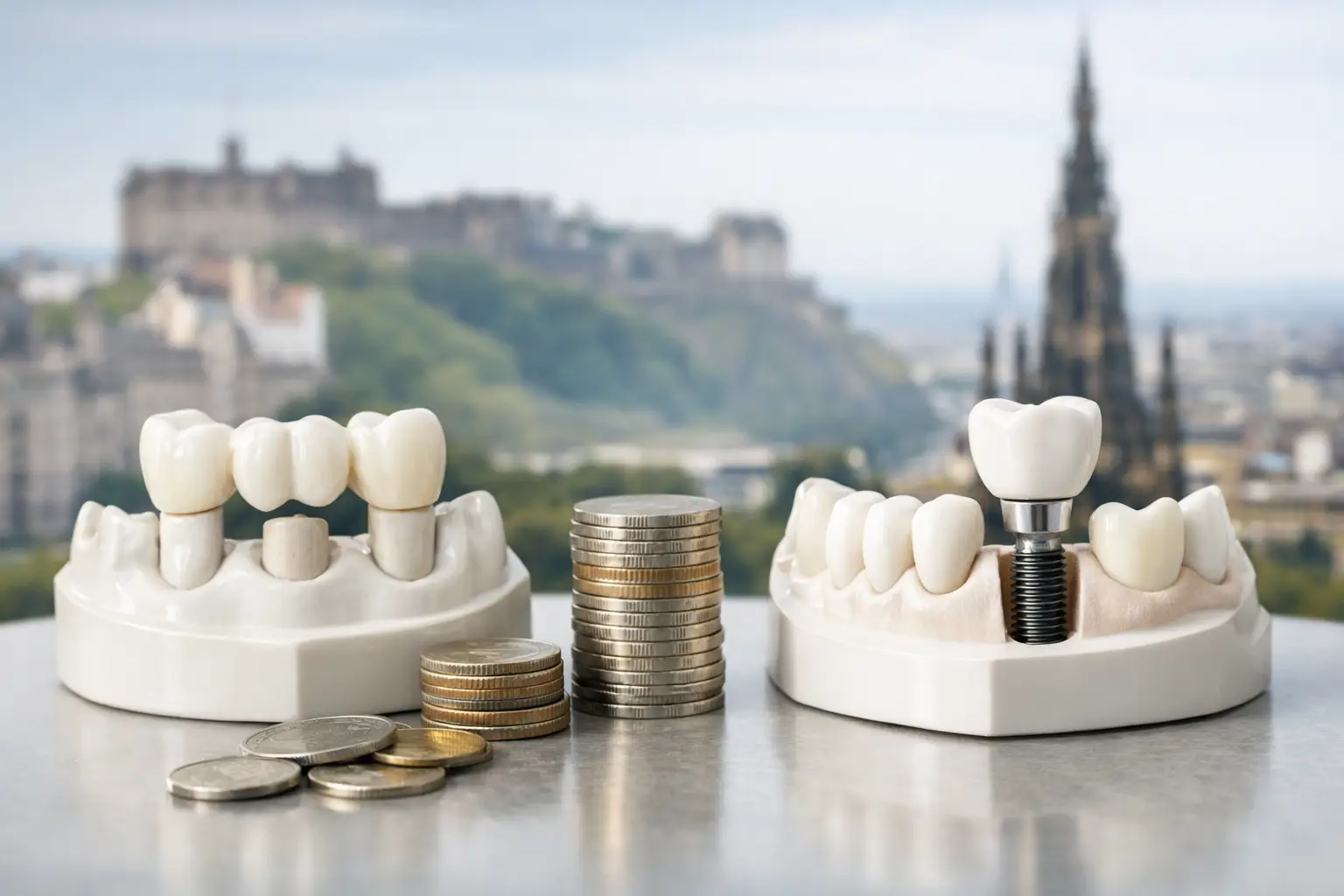
A dental bridge is usually the lower-cost option at the outset. It replaces a missing tooth by attaching a lifelike replacement tooth to the teeth on either side of the gap. In some situations, a bridge may be supported by a crown on one neighbouring tooth, or by a more conservative bonded wing attached behind a nearby tooth.
Private bridge fees vary according to the number of teeth being replaced, the material chosen, the type of bridge and the condition of the supporting teeth. As a broad guide, a conventional private bridge often costs from several hundred pounds per unit, with more complex or highly aesthetic cases costing more. Your dentist should provide a clear written estimate after assessing your mouth.
A dental implant usually has a higher initial cost. It replaces the missing tooth root with a small titanium post placed in the jawbone. Once the implant has integrated with the bone, it supports a custom-made crown. A single private implant treatment commonly costs several thousand pounds, depending on the complexity of the case, the crown selected and whether further procedures are needed.
This higher figure reflects the surgical planning, implant placement, healing period, laboratory work and several appointments involved. It does not mean an implant is automatically the best option for every patient. It simply means it is a different kind of treatment.
What is included in the price?
When comparing quotes, it helps to check that you are comparing like with like. A lower headline price may not include all of the stages needed to complete treatment safely.
For a bridge, the fee may include preparation of the supporting tooth or teeth, impressions or digital scans, a temporary restoration, laboratory-made bridge and fitting appointments. If an old crown needs replacing, or if the supporting teeth need fillings, root canal treatment or gum care first, these are usually planned and priced separately.
For an implant, a full treatment plan may include the consultation, X-rays or a CBCT scan, surgical placement, the implant component, healing review appointments, the connecting abutment and the final crown. Where bone has shrunk after a tooth has been missing for some time, a bone graft or sinus lift may also be required. These procedures add to the overall investment and can extend the treatment timeline.
Asking for an itemised plan is sensible. It allows you to understand what is included, what might change if an unexpected issue is found, and how payments will be staged.
Why a bridge may be the right value choice
A bridge can be an excellent solution when the teeth next to the space already need crowns or have large restorations. Rather than placing an implant, it may be practical to use those teeth to support a replacement tooth at the same time.
Treatment is often quicker than an implant. Once the supporting teeth are ready and the bridge has been made by the laboratory, it can usually be fitted within a matter of weeks. This may suit someone who wants to restore their smile promptly for work, a special occasion or everyday comfort.
Bridges do not require implant surgery, which can feel reassuring for patients who prefer a less invasive route or have medical circumstances that make surgery less suitable. They can also be a helpful option where there is not enough bone for an implant and grafting is not desirable.
The trade-off is that a conventional bridge relies on neighbouring teeth. If those teeth are healthy and untouched, preparing them for crowns may not be the most conservative approach. Bridges also need careful cleaning beneath the replacement tooth. With good oral hygiene and regular reviews, they can last many years, but they may eventually need repair or replacement.
Why an implant can offer long-term value
An implant stands independently, so it does not usually require healthy teeth on either side of the gap to be filed down. For many people, this is its greatest advantage. It replaces both the visible tooth and, in effect, the root beneath it.
The implant can help maintain the bone in the area of the missing tooth. When a tooth is lost, the jawbone gradually changes because it is no longer being stimulated by the tooth root. An implant cannot reverse every change that has already occurred, but it can help preserve the area once it is in place.
Implants also tend to feel secure and natural when eating and speaking. The crown attached to an implant may need maintenance or replacement in time, just like any other dental restoration, but the implant itself can last for many years when cared for properly.
That said, implants are not maintenance-free. Gum disease around an implant can lead to bone loss and, in serious cases, implant failure. Daily cleaning, professional hygiene care and regular dental checks are essential. Smokers, patients with poorly controlled diabetes, and those with active gum disease may need additional care before and after treatment.
The clinical factors that matter more than price alone
The right decision depends on your individual mouth. Your dentist will assess the gap, the health of the neighbouring teeth, your gum condition, your bite and the amount of bone available. They will also discuss your medical history, expectations and how you feel about the treatment process.
If the teeth beside the gap are strong and unrestored, an implant may preserve more natural tooth structure. If they already need crowns, a bridge may be a very sensible and efficient choice. If the missing tooth is at the back of the mouth and is not affecting function, you may decide not to replace it at all. In other cases, particularly where a front tooth is missing, restoring the space may be important for appearance, speech and confidence.
Time is another consideration. A bridge is often completed more quickly. Implant treatment commonly takes several months because the implant needs time to heal and integrate with the jawbone. There are circumstances where an implant can be placed immediately after extraction, but this is not appropriate for every case.
NHS and private treatment in Scotland
NHS dental treatment in Scotland is free where it is available and clinically appropriate. A bridge may sometimes be offered through NHS care, although the choice of design and materials may be more limited than with private treatment. Availability and suitability should always be discussed with your dentist.
Dental implants are rarely available through NHS dentistry except in exceptional clinical circumstances. Most implant treatment is therefore provided privately. This can feel like a substantial commitment, so it is reasonable to take time, ask questions and consider a phased plan where appropriate.
At 4 Great Stuart Street, treatment planning is approached with the same care whether you are considering a straightforward bridge or a more advanced implant case. The aim is to give you clear options, honest costs and enough information to decide without pressure.
Looking beyond the first invoice
A bridge may cost less initially but could require replacement after a number of years, especially if the supporting teeth develop problems. An implant costs more at the beginning, yet it may protect neighbouring teeth and offer a durable solution when properly maintained. Neither outcome is guaranteed, because longevity is influenced by oral hygiene, diet, clenching or grinding, gum health and regular professional care.
It can be helpful to think of the cost in terms of what you are protecting as well as what you are replacing. A well-planned restoration should support comfortable function, healthy teeth and gums, and a smile that feels like your own.
If you are weighing up a bridge or implant, arrange a consultation and bring your questions with you. A calm discussion of your priorities, clinical needs and budget can make the next step feel much clearer.