Dental Bridge vs Implant: Which Suits You?
Comparing dental bridge vs implant? Learn the key differences in cost, comfort, longevity and suitability to choose the right option for you.
Losing a tooth often leaves people with two immediate questions: how quickly can it be replaced, and what will feel most like a natural tooth? When weighing up a dental bridge vs implant, the right choice is rarely about one option being universally better. It is about your mouth, your health, your budget and what matters most to you over time.
For some patients, a bridge is the most sensible and straightforward answer. For others, an implant offers the strongest long-term fit. A calm, informed assessment matters because replacing a missing tooth is not only about appearance. It can affect comfort, speech, chewing, bite stability and confidence as well.
Dental bridge vs implant: the main difference
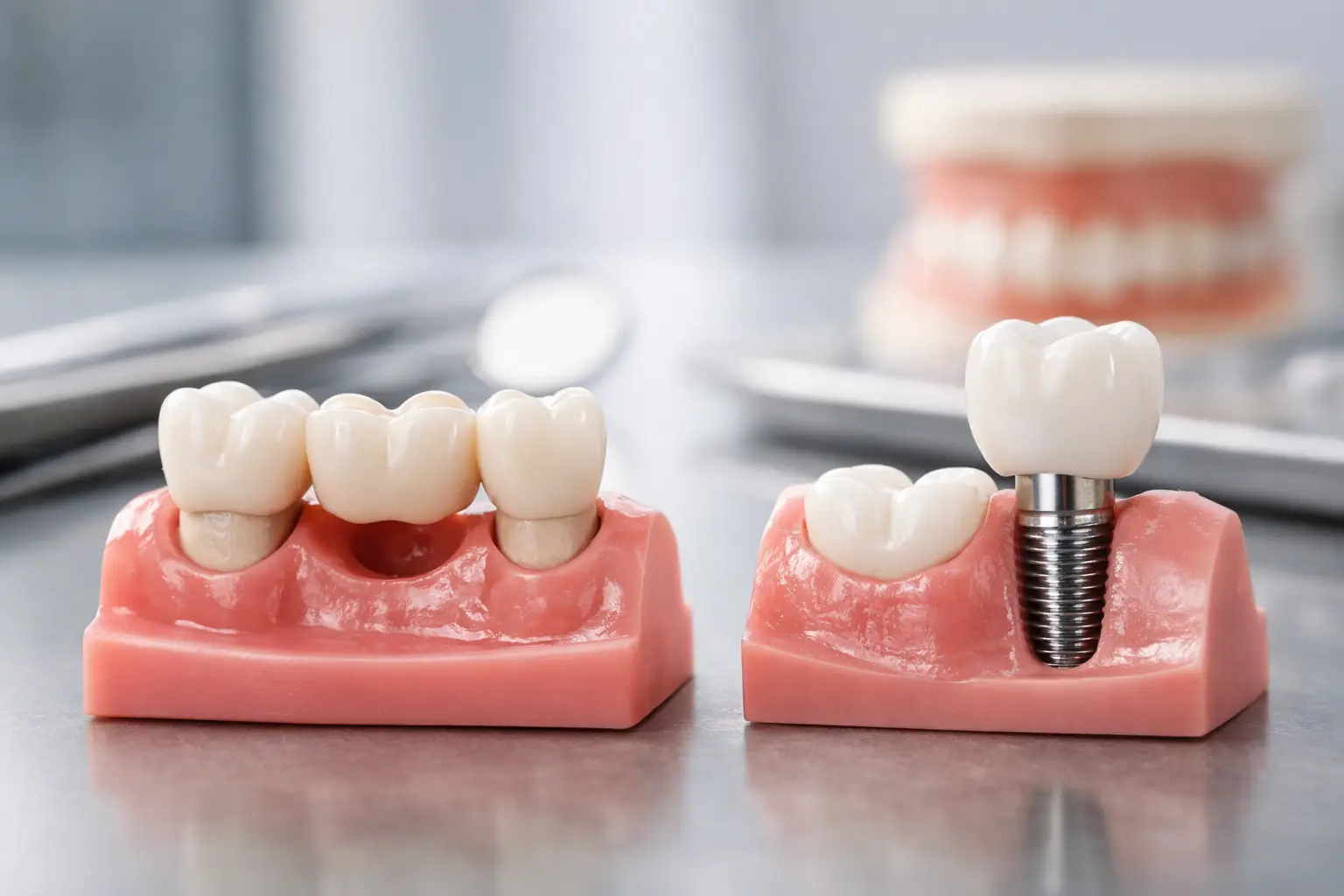
A dental bridge replaces a missing tooth by using the teeth on either side for support. In most cases, those neighbouring teeth are prepared for crowns, and the replacement tooth sits between them as part of one joined restoration.
A dental implant works differently. Rather than relying on neighbouring teeth, it uses a small titanium post placed in the jawbone to act as an artificial tooth root. Once healed, a crown is fitted on top.
That distinction shapes almost every other difference between the two. A bridge is tooth-supported. An implant is bone-supported. One may be quicker to complete, while the other may preserve surrounding structures more effectively in the long term.
When a bridge may be the better choice
A bridge can be an excellent option when the teeth beside the gap already need crowns or substantial restoration. In that situation, using them to support a bridge can make practical and financial sense.
It can also suit patients who want to replace a tooth relatively quickly and avoid oral surgery. Not everyone is comfortable with the idea of an implant, even when clinically suitable. Some prefer a less invasive route, particularly if they are anxious about treatment or want a shorter treatment timeline.
Bridges are also often helpful where there is insufficient bone for an implant and the patient does not want additional procedures such as bone grafting. In these cases, a bridge may provide a stable and attractive result without extending treatment.
That said, bridges depend heavily on the health of the supporting teeth. If those teeth are weak, heavily worn or affected by gum disease, a bridge may not be the best foundation.
When an implant may be the better choice
An implant is often the preferred option when the surrounding teeth are healthy and untouched. Because an implant stands independently, it avoids preparing adjacent teeth that may otherwise not need treatment.
Many patients also choose implants because they tend to feel closer to a natural tooth in day-to-day use. They are fixed in place, do not rely on other teeth for support and can offer very good stability for biting and chewing.
Another important factor is the jawbone. After a tooth is lost, the bone in that area can gradually shrink over time because it is no longer being stimulated by a tooth root. Implants help maintain that stimulation. While they do not stop all natural change, they can help preserve bone better than a conventional bridge.
An implant may also be the stronger long-term option for a single missing tooth in a healthy adult who is committed to good oral hygiene and routine maintenance.
Appearance and comfort
Both bridges and implants can look very natural when carefully planned and well made. The visible part of each restoration is designed to blend with your existing teeth in shape, size and colour.
Comfort is a little more personal. Some people adapt quickly to a bridge and are entirely happy with it. Others notice that cleaning around it takes more effort or that food catches beneath the replacement tooth.
Implants often feel more like natural teeth because they emerge through the gum in a similar way to a real tooth and do not connect to neighbouring teeth. Even so, they are not completely maintenance-free. They still need careful cleaning around the gumline, and regular reviews are important.
Treatment time and what to expect
If speed is the priority, a bridge is often quicker. Once the supporting teeth are prepared and impressions are taken, the final bridge can usually be fitted over a relatively short period.
Implants usually take longer because healing is part of the process. After the implant is placed, the bone needs time to integrate with it before the final crown is fitted. Depending on the case, this may take several months.
That longer timeline is worthwhile for many patients, but it is not ideal for everyone. If you have an urgent need to restore function or appearance, a bridge may be the more practical route. If you are focused on the long view and are happy to wait, an implant may be worth considering.
Cost now and cost over time
Cost is understandably part of the decision, and this is one area where honesty matters. In many cases, a bridge has a lower upfront cost than an implant. That can make it feel more accessible at the start.
However, the initial fee is only part of the picture. A well-maintained implant can last for many years, and because it does not depend on neighbouring teeth, it may reduce the chance of future treatment on those teeth. A bridge can also last well, but if one of the supporting teeth develops decay, fracture or gum problems, the whole restoration may be affected.
This does not mean implants are always better value. It means value depends on the condition of your mouth now, your likely maintenance needs and your priorities. For some patients, the lower initial cost and shorter treatment time of a bridge are exactly right. For others, the longer-term independence of an implant justifies the extra investment.
Maintenance and longevity
Neither option should be thought of as permanent in the sense of needing no future care. Both bridges and implants require regular examinations, hygienist visits where appropriate and careful home cleaning.
Bridges need special attention underneath the false tooth, where plaque can build up if cleaning is difficult. Interdental aids are often needed. The supporting teeth also need to remain healthy, as they carry the load.
Implants need healthy gums and good plaque control to reduce the risk of inflammation or peri-implant problems. Smoking, poorly controlled diabetes and inconsistent cleaning can all affect long-term success.
In general, implants have the potential for excellent longevity when well planned and well maintained. Bridges can also serve patients very well for many years, especially where case selection is good and the supporting teeth are strong.
Who may not be suitable right away?
Suitability is never decided by the missing tooth alone. Gum health, bone levels, bite forces, general health and even habits such as grinding can influence the best option.
An implant may not be suitable immediately if there is active gum disease, insufficient bone, certain medical considerations or smoking habits that increase risk. Sometimes these issues can be managed first. Sometimes a bridge remains the more sensible option.
A bridge may be less suitable if the adjacent teeth are completely healthy and would need significant drilling, or if they are too weak to support the restoration predictably.
This is why good treatment planning matters so much. A proper examination, x-rays and a discussion of your goals will usually make the decision clearer.
Dental bridge vs implant: questions worth asking at your consultation
Patients often feel more confident when they know what to ask. It can help to discuss how long each option is likely to last in your specific case, whether neighbouring teeth need treatment anyway, how easy each option will be to clean and what the full cost includes.
It is also worth asking about the likely timeline, whether any preparatory treatment is needed, and which option your dentist would choose if this were their own tooth. That last question can prompt a very honest and practical conversation.
At an established practice such as 4 Great Stuart Street, that discussion should feel measured rather than pressured. Missing teeth can affect confidence, but decisions about replacing them should still be made carefully.
So which is better?
The most useful answer is that neither treatment wins in every situation. If the supporting teeth already need crowns, if you want a quicker solution, or if surgery is not right for you, a bridge may be the best fit. If the neighbouring teeth are healthy, bone levels are suitable and you want an option that stands alone, an implant may be the stronger choice.
What matters most is not choosing the treatment that sounds most advanced. It is choosing the one that is clinically sound, comfortable for you and realistic to maintain.
If you are deciding between a bridge and an implant, the next step is not to guess. It is to have the gap, the surrounding teeth and your wider oral health assessed properly, so the choice feels clear and reassuring rather than uncertain. That usually leads to the best result - and greater peace of mind.