Bridge Versus Partial Denture: Which Suits You?
Considering a bridge versus partial denture? Understand comfort, cost, care and suitability, so you can discuss the right tooth replacement option today.
A missing tooth can affect more than the look of your smile. It may change how comfortably you chew, how clearly you speak, and how confident you feel in everyday conversations. When considering a bridge versus partial denture, the right answer is rarely the same for everyone. Both can restore function and appearance, but they do so in different ways and suit different mouths, priorities and budgets.
A careful dental examination is the starting point. The number and position of missing teeth, the condition of your remaining teeth and gums, your bite, and your long-term oral health all matter. A good recommendation should feel considered, not rushed.
What is a dental bridge?
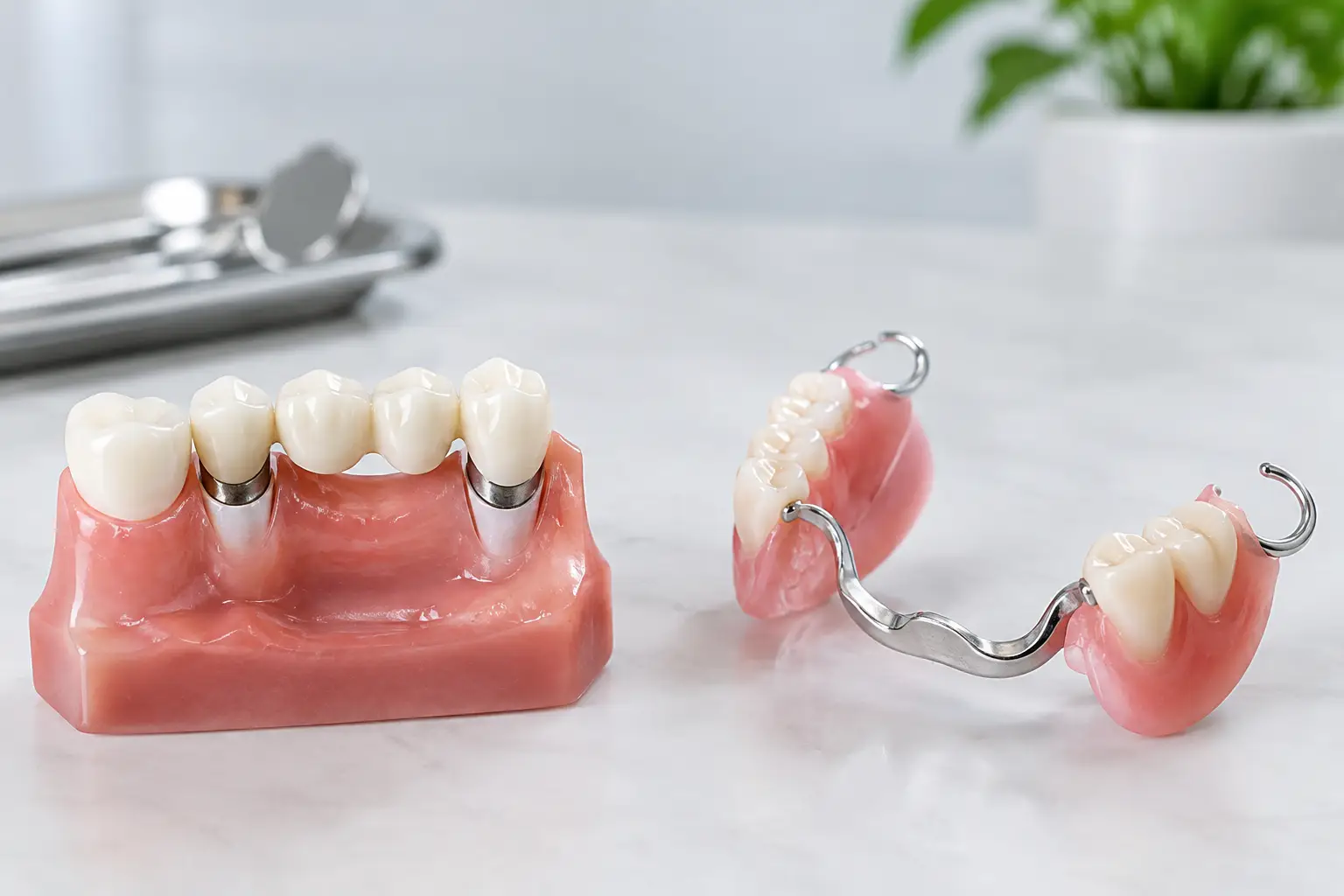
A dental bridge is a fixed restoration used to replace one or more missing teeth. It is commonly supported by the natural teeth on either side of the gap, known as abutment teeth. These supporting teeth are prepared to receive crowns, with an artificial tooth or teeth held between them.
Because a bridge is fixed in place, it is not removed at home. For many patients, this gives a reassuringly stable, natural feel when eating and speaking. Modern bridges are made to blend closely with surrounding teeth in shape and colour, particularly where appearance is a priority.
There are several bridge designs. A conventional bridge is often appropriate where the supporting teeth already need crowns or have large fillings. In some cases, an adhesive bridge may be considered, especially for a single missing front tooth. This type is bonded to the back of a neighbouring tooth and usually requires less preparation. The most suitable design depends on the position of the gap and the strength of the teeth available to support it.
The advantages of a bridge
A bridge remains in the mouth, so there is no daily removal or need to store it overnight. It can feel more secure than a removable option and usually allows comfortable chewing once you have adapted to it. It can also prevent neighbouring teeth from drifting into the space left by a missing tooth.
For a visible gap, a well-made bridge can provide an attractive, discreet result. It is often a particularly practical option when the teeth beside the gap already require restoration.
The considerations with a bridge
A conventional bridge relies on the health and strength of the supporting teeth. These teeth need to be shaped to accommodate crowns, which is an irreversible change. If they are entirely healthy and untouched, your dentist will discuss whether this is the most conservative choice.
Cleaning also needs care. Although a bridge cannot be removed, plaque can build up around its edges and beneath the artificial tooth. Special floss, interdental brushes or floss threaders may be needed to clean effectively. Without consistent hygiene and regular check-ups, the supporting teeth and gums can become vulnerable to decay or gum disease.
A bridge can last well for many years, but it is not permanent. Its lifespan depends on bite forces, cleaning, the quality of the supporting teeth and regular professional care.
What is a partial denture?
A partial denture is a removable appliance that replaces one or more missing teeth. It may be made from acrylic, metal, or a flexible material, depending on the design and clinical need. Replacement teeth are attached to a base that rests on the gums, while clasps or carefully designed components help hold the denture in position around remaining teeth.
Partial dentures can replace teeth in several areas of the mouth without requiring crowns on neighbouring teeth. They are therefore often useful where there are multiple gaps, where the teeth around a space are not suitable bridge supports, or where a patient prefers a more affordable removable solution.
The advantages of a partial denture
The main benefit is versatility. A partial denture can replace several teeth, including teeth that are not next to one another. It can be designed without significant alteration to natural teeth, which may preserve more tooth structure than a conventional bridge.
It is also usually more straightforward to adjust or add teeth to if your dental needs change in future. This can make it a sensible solution for patients whose remaining teeth need ongoing monitoring.
Modern dentures are more refined than many people expect. A carefully planned, well-fitted partial denture can restore the shape of your smile and provide useful support for eating and speaking. However, it is fair to say that removable appliances usually require an adaptation period.
The considerations with a partial denture
A partial denture needs to be removed for cleaning, usually after meals where practical and always before bed. It should be brushed with an appropriate denture brush and cleaned as advised by your dental team. Your gums, tongue and natural teeth still need thorough daily cleaning too.
Some people notice a little movement at first, particularly when eating certain foods. A denture may also feel bulkier than a fixed bridge, and it can take time for speech and chewing to feel entirely natural. Adjustments are common in the first weeks and are part of achieving a comfortable fit.
Over time, the shape of the gums and jaw can change, meaning a denture may need adjustment, relining or replacement. This is normal and is one reason regular reviews remain valuable even when you have no discomfort.
Bridge versus partial denture: the practical differences
The most noticeable difference is that a bridge is fixed and a partial denture is removable. For someone who wants a tooth replacement to feel as close as possible to a natural tooth, a bridge may be more appealing. For someone replacing several teeth, or wishing to avoid preparing neighbouring teeth, a partial denture may be the more suitable route.
Comfort is personal. A bridge generally feels less intrusive because it does not cover the palate or rest across the gums in the same way a denture can. Yet a well-designed partial denture may be more comfortable than a bridge if the supporting teeth are weak, heavily restored or affected by gum problems.
Cost is also an understandable consideration. A partial denture is often less expensive initially than a fixed bridge, especially when several teeth are missing. However, value should be judged over time rather than only at the first appointment. Future adjustments, repairs and replacement, as well as the maintenance needs of either option, should be part of the conversation.
Which option is kinder to your remaining teeth?
This depends on the individual situation. A conventional bridge can protect a damaged supporting tooth by covering it with a crown, while also replacing the missing tooth beside it. In that setting, it may be an efficient and sensible treatment.
Where neighbouring teeth are healthy, a removable partial denture may avoid the need to reduce them. On the other hand, poorly fitting dentures or dentures that are not cleaned properly can place pressure on gums and trap plaque around the teeth they rest against. Neither option is automatically better for every mouth. Design, fit and home care make a real difference.
An implant-supported crown or bridge may also be discussed in some cases. Implants can replace a missing tooth without relying on neighbouring teeth, but suitability depends on bone levels, general health, healing factors and budget. They are not the right choice for everyone, and they require the same commitment to hygiene and review appointments.
Questions worth asking at your consultation
It can help to ask how each option would affect your remaining teeth, what cleaning routine will be required, and what you should expect in the first few weeks. You may also wish to ask about likely longevity, repair options and the full costs involved, including future maintenance.
At 4 Great Stuart Street, treatment planning is approached as a conversation. The aim is to understand what matters to you, whether that is a fixed feel, preserving healthy teeth, managing costs carefully, or finding a replacement that feels manageable after a difficult experience with dentistry.
Caring for your chosen replacement
Whether you choose a bridge or partial denture, daily cleaning and regular dental reviews protect the investment you have made. Bridges need careful cleaning around the supporting crowns and under the false tooth. Partial dentures need to be removed, cleaned gently and checked for changes in fit.
If you notice soreness, looseness, food trapping, a change in your bite, bleeding gums or damage to the appliance, arrange an appointment rather than trying to manage it alone. Small concerns are often easier to address early.
The best tooth replacement is the one that supports your health, comfort and confidence over the years ahead. A calm discussion with your dentist can turn a difficult choice into a clear, well-supported decision.